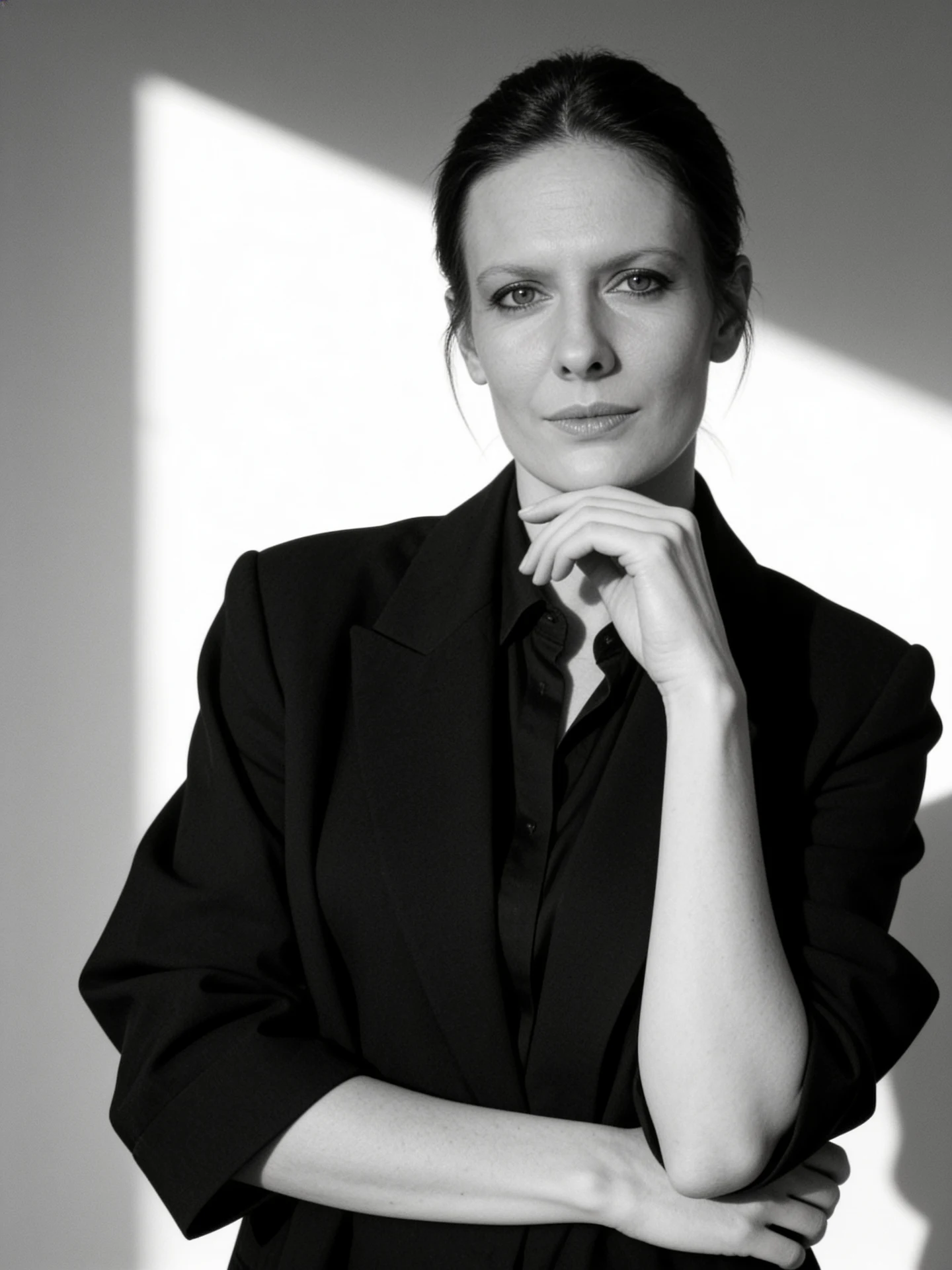
Helene MalyutinaPhoto from the interviewee’s personal archive.
INTERVIEWFOUNDER STORYWARSAW
“Machines see people, but miss the system.” Helene Malyutina on BEHAVE, Physical AI, the mathematics of human behaviour and Palantir’s interest.
A robot can see everyone in a room and still miss how people affect one another. Helene Malyutina set out to describe that dynamic mathematically. In 2026, she published a preprint on BEHAVE, a model of collective behaviour for Physical AI. She is now building Shiftfield on that foundation for developers of autonomous systems. In this interview with BYGRID, Malyutina explains what question outlasted two of her startups and how to spot the early signs of a crowd crush, even when people seem to be moving as usual.
Contents
01A letter from Palantir
“I was standing there with a glass of wine and suddenly realised how far I’d come”
It’s an ordinary evening and suddenly Palantir emails you. Does that happen often?
— I remember it almost frame by frame. I’m at home one evening, pouring a glass of Italian red wine, and my phone lights up: “Hi BEHAVE team, we're very excited about what you're building. We'd love to set up a call and learn more about your company and team…” Signed: Palantir.
It was a standard corporate email, but I couldn’t believe my eyes. I stood there with my glass and thought, ‘Look how far you’ve come.’ A year earlier I’d felt hollow, my ego shattered, as if I’d died socially. Now Palantir wanted to talk about my mathematical model.
There had been months of R&D, mistakes, research and experiments. The harder part was personal: coming out of depression and figuring out who I was and what I wanted to build. Of course, an email can’t establish the technology’s potential. There’s still a lot to validate.
But in that moment I could see clearly the distance between those two points in my life, and I felt a quiet respect for myself. I finally took a long sip of Italian red and put the phone down.
What happened next?
— We had a call, went through an interview, and continued discussions, including organisational matters. The visa situation of our technical lead became a practical obstacle, as the programme required the team’s in-person participation.
I take it as a small nod that we might be working on something that matters. Palantir works with complex systems, data and operational decision-making, so I was particularly interested in discussing our research question with a product team at that level.
Photo from the interviewee’s personal archive.
A machine can see every person, know their position, speed and trajectory, and still be blind to the system they form. A human group is a complex dynamical system.
03How to spot a crowd bottleneck
“The best outcome is an event that never happened”
What were you able to demonstrate experimentally?
— One of the most interesting experiments looked at people moving through a narrow passage. Using public data from Jülich, we found statistically significant differences in how people’s movements were organised and saw signs of a jam 12 seconds before it developed. Twelve seconds is a lot! That can be enough time to save lives. In another experiment, on the DIAMOR data, adding information about interactions helped identify actual groups better than a model based on proximity.
So you want to warn people about a crisis before it happens?
— Exactly. Today a crowd crush, a conflict or a production stoppage can be the event that triggers an investigation. I’m interested in the state of the system beforehand, while the crisis can still be prevented. It’s a shift from documenting the consequences to looking for early signs of a change in how the system behaves. The paradox is that the best outcome for our technology is an event that never happened.
04Lessons from Artyline and FAMS
“Being right about the future isn’t enough”
Before BEHAVE you built two startups, raised funding, brought products to market and shut the companies down. How did that experience shape your work today?
— Enormously. Artyline, an app that turned pencil sketches on paper into interactive digital mock-ups, taught me to distinguish technological potential from market readiness. In 2018 we built a product, raised funding and got paying customers, but missed our window in B2B. In B2C we were too early: similar technology was built and sold a year ago. Ever since, I’ve added my own question to investors’ favourite ‘Why now and not yesterday?’ I ask, ‘Why now and not tomorrow?’ Being right about the future isn’t enough. You have to get the timing right.
FAMS taught me something different. We raised money for an interactive product for parents and turned our own AI character engine into a commercial offering for game studios. But the rapid development of foundation models changed the competitive landscape. After looking at the prospects and economics, we decided to stop operating the company in its existing form.
Looking back, I see how much those projects taught me as an entrepreneur. Artyline taught me to turn a technology into a product. FAMS taught me to study the consequences of human decisions and find commercial value in the technology we had developed.
BEHAVE brought those strands together with my engineering background and interest in complex systems. I have a better sense now of what I want to build and what it would take for the technology to become a large, sustainable business.
I came to a calm, clear understanding that each of those stages had a purpose. Each gave me something without which BEHAVE might never have come about.
How did you come to the idea of analysing environments where robots might operate?
— After FAMS closed, I went through a difficult period. I kept replaying decisions, experiences and mistakes. I later learned that cognitive psychology has a concept called insight through restructuring. Something triggers the information you’ve accumulated to fall into a completely new pattern. For me, it happened quite unexpectedly. One of my investors and his wife gave me a photo shoot. I arrived, we got to work, and the photographer suddenly said, ‘There’s something really beautiful about your gaze.’ It struck me how long I’d been looking at myself entirely through my achievements, decisions and their consequences. For a second, I saw myself differently.
On the drive home something shifted. Suddenly I saw connections between all my interests, feelings and experiences. There’s a basic principle in dialectics: quantitative changes can lead to a qualitative change. That’s what happened in the car. My experiences and ideas, and the connections between them, came together in a new way. That was the idea for BEHAVE.
Where did your interest in human systems on that scale come from?
— At school I competed in academic Olympiads and was fascinated by how civilisations evolve, by geoeconomics and geopolitics. I wanted to understand how millions of decisions shape the course of societies. Why do some systems stay stable while others change the way they develop?
My engineering education in information technology and control of technical systems gave me another language: states, feedback loops, stability and control inputs. In dynamical systems theory there’s the idea of bifurcation, which we discussed earlier. I’ve always been fascinated by how gradual changes can bring the whole system into an entirely different state.
I began to wonder why I treated those as separate intellectual worlds. What if they were two sides of the same coin, and we could study human systems using the mathematics of control theory? Today BEHAVE works with observable groups in physical spaces. I’m also interested in larger scales, such as organisations, societies and civilisations, especially after companies like Palantir showed interest.
Photo from the interviewee’s personal archive.
I want to raise money as late as possible. First I want to understand the technology and the market, then validate the value and the economics. Only then do I want to raise capital for a specific purpose, when I know what it needs to accelerate.
If you found this article useful, treat the editorial team to a coffee. Your support helps us continue connecting with company founders and sharing their experiences.
Treat the team to a coffee (opens in a new tab)Julia Nekhai