
Research / HealthTech
·9 min read
New Startups, Same FoundersWho Is Building HealthTech with Belarusian Roots Today?
After 2020, startups with Belarusian roots became dispersed across countries, while the startup ecosystem — already fairly limited — contracted further. Yet new companies continue to emerge. Three quarters of the projects are being built by founders who have already started a business.
- 28
- Startups in the study
- 30+
- Companies on the map
- 75%
- Previously started a business
- 79%
- Target global markets
Contents
00About the research
The BYGRID HealthTech startup map
That is one of the findings of HealthTech in Motion, a study conducted by DŌBRA. It draws on a startup map compiled with contributions from the Belarusian startup community: DŌBRA, Axios and Angels Band. The map currently includes 30+ companies operating outside Belarus. Based on publicly available information, the study covered 28 active projects. Its methodology was verified together with the Angels Band business angel network.
012024 and the new wave
2024 and the surge of a new wave
Half the sample took shape over the past three years: 14 of the 28 active startups were founded in 2023–2025. The standout year was 2024, when almost a third of the companies were established.
The sample is far from uniform: alongside small projects are several companies operating at a very different scale. Flo Health, for example, launched in 2015 and became Europe’s first femtech unicorn. Its app now has 77 million monthly active users, and its team comprises hundreds of employees across countries. Zing Coach is an AI fitness platform with more than 2.5 million users in 180 countries. Following its consumer product, it is developing an institutional offering, with partners including New York Sports Club and Paris Saint-Germain.
02Teams and founder experience
Up to 10 people, but with experience building a business
Very small teams nevertheless dominate. Three quarters of the startups (21 of 28) have up to 10 employees; another four have between 11 and 50. Only three companies have teams of more than 50 people.
Most projects are launched by experienced entrepreneurs: founders at 75% of the startups have already run their own business, and at least two have an exit behind them. For only 21% of the projects is the current startup the founders’ first. Even among those are people with strong startup and product backgrounds: before launching their own projects, they worked at Flo, GanttPro, SplitMetrics, MSQRD and other well-known companies. The small size of many projects therefore says more about their stage than a lack of entrepreneurial experience.
Team size is an approximate scale estimate based on company LinkedIn profiles, not a headcount.
03Geography and markets
Poland is the main hub; nearly everyone targets a global market
Almost a third of the sample is based in Poland: 8 of the 28 companies. The rest are based in Lithuania, the US, the UK, Germany, the Netherlands, Switzerland, Denmark, Kenya and Cyprus. The location of two projects could not be determined.
Meanwhile, 79% of the startups target the global market. A clear national or regional focus could be identified for only five.
Location is based on current company LinkedIn profiles; it could not be determined for two projects.
04Focus areas and products
From mental health to assessing skin problems
The startups address a wide range of needs: women’s and family health, heart rate and blood pressure monitoring, skin problems, interpreting lab results and symptoms, managing stress and anxiety, support for ADHD, and improving nutrition and sleep, among others.
There is no dominant segment. The two largest are diagnostics and monitoring, and mental health and emotional wellbeing. Each accounts for 6 of the 28 projects (21.4%).
05Business models
Almost half are B2C only; a third combine several models
46% of the sample operates exclusively as B2C, and 18% exclusively as B2B. The remaining 36% combine work with end users and organizations or use a B2B2C model.
Skinive is one example: alongside its consumer app, the startup develops Skinive MD for professionals and offers its technology through an API/SDK. Publicly announced integrations include a project with DaVinci Salute (Unipol Group), a platform with around 700,000 users.
In addition to its consumer product, Soula has a separate offering for employers, which was tested in a pilot with inDrive, the international passenger transport and urban services platform.
Body Bloom AI says it is preparing its first pilots of a white-label product for clinics.
06Interview: Kirill Voloshin
“The experienced, well-connected and financially secure survive”
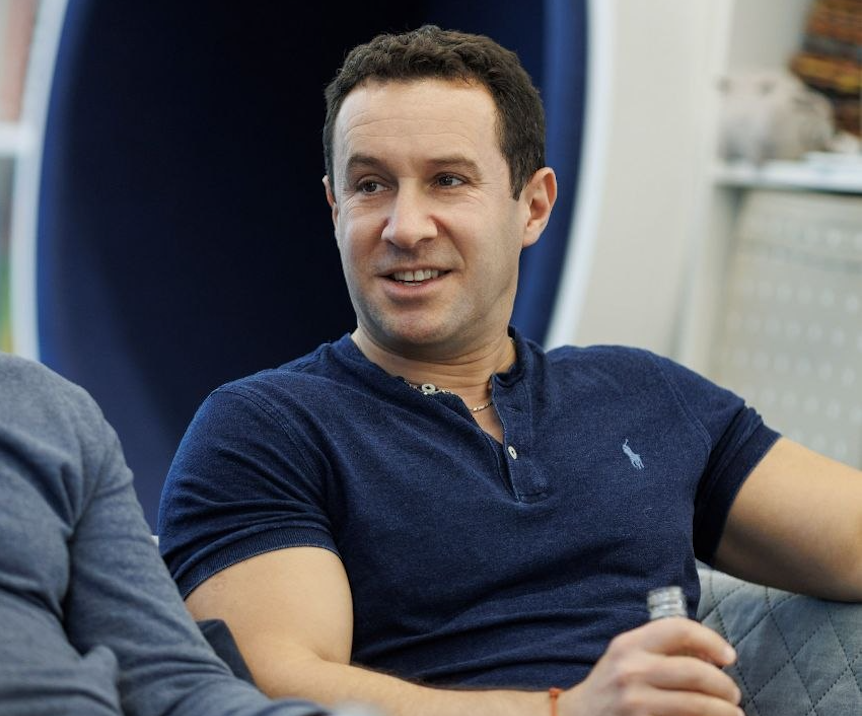
“The experienced, well-connected and financially secure survive”
Kirill Voloshin
CEO, Angels Band · author of ‘Ребятам о BY-Стартапах’
Although this distributed startup ecosystem has no single center and almost no institutional infrastructure of its own, it continues to reproduce itself. One mechanism is the experience accumulated by founders. We asked Kirill Voloshin, CEO of Angels Band and author of the Telegram channel “Ребятам о BY-Стартапах”, to comment on the study. In his view, the high share of repeat founders may reflect a higher barrier to entry for new founders more than the strength of a distributed community.
— You have worked with early-stage startups for many years. Do you see this pattern of new companies being created by people who have already launched startups or run their own businesses? Can entrepreneurs’ accumulated experience, connections and capital partly replace the missing infrastructure?
— Yes, I do, and it is to be expected. But it is hardly good news. In a healthy ecosystem, the share of first-time founders is high because there are people to support them in different ways. That is a motivating factor, and entry itself is inexpensive. When normal infrastructure is missing, the barrier to entry rises sharply. So three quarters being repeat founders is the result of (un)natural selection. Those who survive are experienced, have seen a lot, are well-connected and have money. Personal networks replace deal flow, funds are more receptive and relationships with them are already warmer, reputation helps with due diligence, and raising pre-seed is easier, including through former colleagues. But personal experience only scales your own projects. That is why we hear relatively few names, and many recur year after year. So do the founders’ former workplaces: some are from the Flo ‘mafia’, by analogy with the Skype/YC ‘mafia’, others from MSQRD, Wargaming and so on. Unfortunately, no significant new talent factories have emerged in recent years.
— We face an unusual situation: infrastructure providers can be counted on one hand, and the startup ecosystem has no shared territory either. Can we speak of it as a single ecosystem at all? Where is the weakness in this distributed model, and does it have any strengths?
— No, we cannot speak of a single ecosystem. In an ecosystem, a founder can go all or most of the way from idea to exit without leaving it. Ideally, some of that money also flows back into the ecosystem to support the next generation of startups. Belarusians have a community distributed within other people’s ecosystems. Founders make their journey there; what remains in the Belarusian part is their origin and some of their networking.
Looking at the elements: capital, the most painful issue — there is no institutional layer at all, almost no funds of our own, few angels, and those angels have become more cautious. Project deal flow is poorly visible and unsystematic; people in the same vertical often do not know that others exist. Apart from Angels Band, hardly anyone is working on the funnel. Last season, active pre-acceleration and acceleration were available only at Angels Band (thanks to EBRD) and in EdTech (thanks to Lithuania). Local accelerators are also objectively stronger: they have money, corporate partners and local networks. On the positive side, Belarusian founders who have left the country have access to several Western ecosystems, and trust within the community is relatively high.
— How successfully are founders using the infrastructure of these more developed ecosystems, such as Poland and Lithuania?
— Belarusians do use the infrastructure in Poland and Lithuania, but in my view very unevenly. It depends less on the country than on whether a founder has invested in a local network or continued living in a Slavic bubble. Formally, almost everything is accessible, and there are few barriers if you speak the language.
Poland is the sample’s main hub, and it is easy to see why: a large domestic market, less expensive teams, many accelerators and public funding. Polish VC also tends to have a local focus: it readily invests in projects with a local starting market.
Lithuania is a small market, so everyone goes global from day one. That is quite useful, but not every Belarusian founder can manage it. The ecosystem is more tightly connected and in some ways more accessible: two phone calls can get you to the right person; LitBAN and local funds are very active. Funds from abroad also readily consider local projects. Corporate implementations and partnerships are harder, though. Without a reputation and Lithuanian language skills, things will move slowly.
To sum up: there is no Belarusian infrastructure in either country, and access to local infrastructure does not come just from arriving. You have to actively become part of it: join a local accelerator, bring local people into your team or on board as advisors, attend local events, and speak the language of local investors — figuratively and literally. Those who relocated but continued working and socializing within their old circles live on their savings and checks from friends.
07What comes next
Despite difficult conditions, new companies continue to emerge
Belarusian founders continue to find opportunities in different countries and ecosystems. Experience, connections and international integration help compensate for the absence of their own infrastructure. Yet the high barrier to entry remains a challenge for new entrepreneurs.
08Methodology and limitations
How we collected the data and what to keep in mind
The sample included international HealthTech startups with at least one founder with Belarusian roots and core operations outside Belarus. A project had to show signs of activity within the previous six months and have at least a working MVP with evidence of use or testing beyond the founding team. Inactive projects were not included in the sample.
HealthTech is used here as an umbrella category for technologies and digital products addressing specific physical or mental health needs: prevention, diagnostics, treatment, condition monitoring, healthcare delivery and health management. Products focused on productivity, habits, time management or general wellbeing without a specific health-related purpose were not included.
Data came from public sources: company websites, startup and deal databases, media, investor and accelerator announcements, and research publications. AI tools were used for searching and initial processing, not as independent sources. Information on funding, research, clinical validation and regulatory status was checked against primary or independent public sources. DŌBRA, Angels Band and Axios participated in verifying the projects.
This is neither an exhaustive list nor a registry of all companies. The study is a snapshot as of September 2026, using data collected in July–August 2026. Non-public projects and companies with a limited digital footprint may be missing. Team size and location were determined from LinkedIn and indicate approximate scale and reported location, rather than exact headcounts or the full geography of operations. Figures may be refined as new confirmed information becomes available.