
Matt GramovichPhoto courtesy of Matt Gramovich.
INTERVIEWFOUNDER STORY
“I like it when two plus two equals five.” Matt Gramovich on Capitaliply, the fund that buys Shopify apps
Matt Gramovich buys Shopify apps with annual recurring revenue (ARR) of $500,000 to $3 million. The portfolio now has eight products. The Capitaliply fund bought six, and the CPTN team built two. Around 14,000 companies worldwide use them, about 40% of them in the US. Ahead of the Future Leaders Forum in Warsaw, where Matt will speak as one of the founders on the Next 35 list, we discussed Capitaliply’s acquisition strategy, the future of e-commerce, and lessons from Zodier — a dating startup with four million downloads that closed after a funding round fell through.
Contents
01Why Zodier shut down
Zodier: Forbes, a failed funding round and a cash shortfall
Let’s start with Zodier, the dating app. Over a few years, you reached four million downloads, Forbes in the US covered you and everything seemed to be going well. Then you put the project on hold and eventually shut it down. What happened?
— Things got difficult in 2022. We were making some money, but our focus was on growing quickly. In early February we launched dating on Instagram, and it took off. Then in early March Facebook blocked the app because of its connection to a Belarusian company.
We were fundraising at the time, and the round fell through when many investors put their investments on hold. We ran short of cash. We had also just received a $100,000 grant from Google, but Zodier was still running on Amazon servers. We couldn’t move a service with several million users over to Google in time. The Amazon servers were expensive to run, and after a couple of weeks we decided to switch them off.
In the meantime, we tried running a staff augmentation business. That went fairly well too, until November 2022. It was a stressful year. Everything seemed to break at once.
02How Capitaliply picks apps
Capitaliply: what the fund buys and how it structures deals
Capitaliply was your next business. What do you do, and how does the fund work with CPTN?
— Capitaliply is a private equity fund that buys assets. CPTN is the product team that runs them. We have eight products in the portfolio now. We bought six and built two ourselves. They include tools for selling subscriptions, taking deposits and splitting payments, and bundling products.
We buy products in the Shopify ecosystem, grow them and bring them together. So far we’ve only acquired assets because those deals are simpler to structure. We’re ready to buy companies too, possibly early next year. In 2026 we looked at more than 20 companies. We’re at the stage of signing a term sheet or letter of intent with several of them.
We’re interested in B2B SaaS businesses with annual revenue of $500,000 to $3 million. We also want the founders to stay with the business for at least a year and help us integrate it. The terms matter more to us than the valuation. The headline valuation can be very high, but it depends on the founders hitting milestones with us over that year.
Why would a founder sell a profitable business? And when do they get paid?
— For the founders it’s a conventional exit, usually all cash. They get some of the money upfront and some three to six months later, after handing over key accounts and sharing what they know about the business. The rest depends on the results after a year or more, according to what we agree.
Why sell? If you’ve built a business yourself and it’s doing $3 million in revenue, you can live quite comfortably. Some founders want to put the money into another business, and some want to retire. A venture-backed founder needs to deliver a multiple on the investors’ money. The businesses we see are mostly bootstrapped, with years of hard work behind them.
How do you decide what you’re willing to pay?
— We’re financial buyers rather than strategic buyers. We look at the internal rate of return (IRR) and the EBITDA multiple. We need free cash flow so we can finance part of the deal with debt. Take a $3 million deal. We put in $1.5 million and borrow $1.5 million. We use revenue from the company we bought to service that debt.
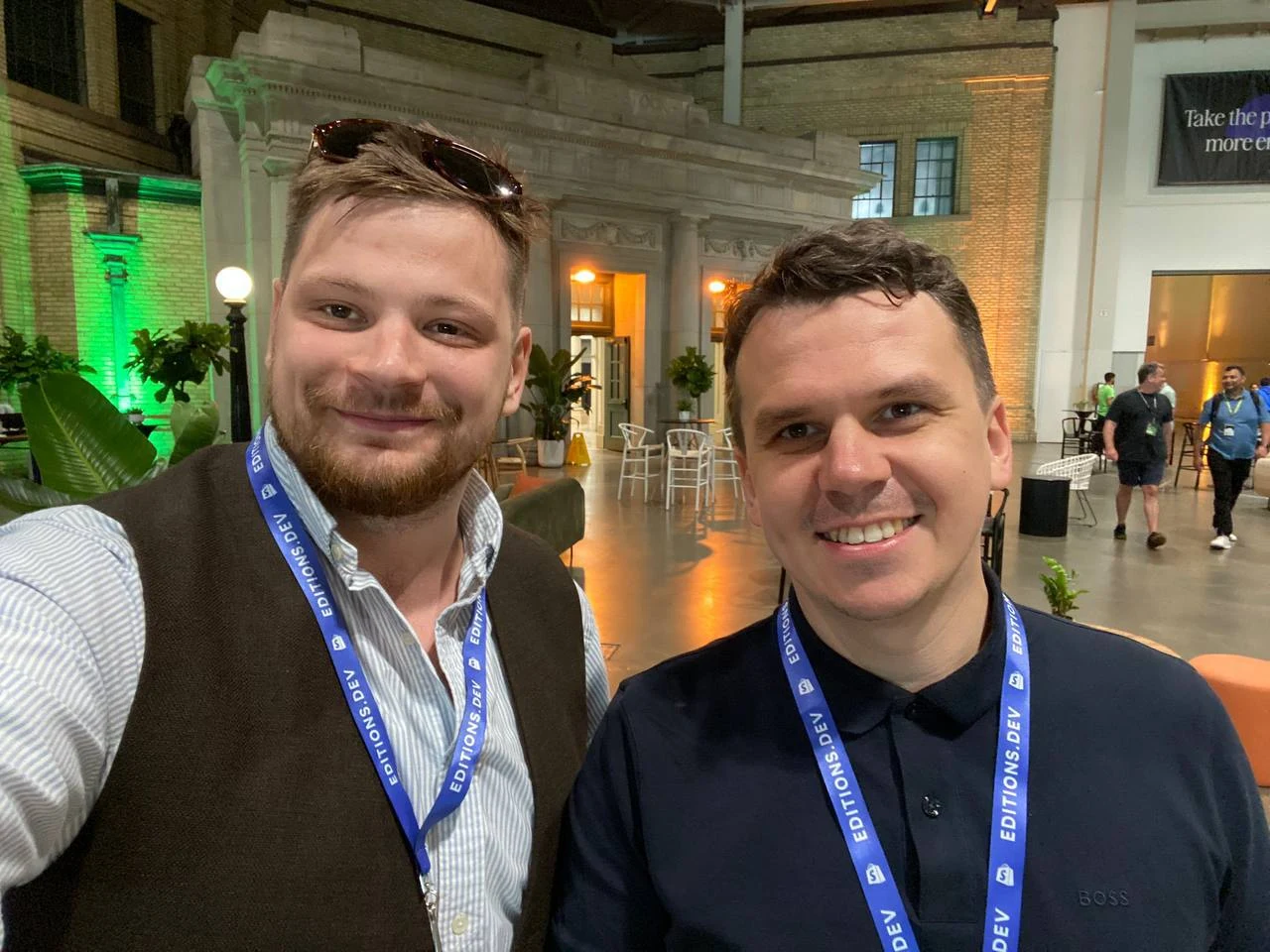
With Dmitri Kruk at Shopify Editions in Toronto.Photo courtesy of Matt Gramovich.
The front end we’re used to seeing in online stores could disappear altogether. There will be other interfaces.
04How AI changes online shopping
How AI is changing e-commerce: vibe coding and chatbots
How is vibe coding affecting the app market? And what is AI changing in e-commerce itself?
— Over the past year we saw plenty of cases where a founder could have a hundred apps in the store. Shopify has since tightened its rules. Before you can launch a second product, your first one needs to reach a certain number of installs.
I think Shopify is at the forefront of AI adoption. The biggest trend I see is that e-commerce is moving into chatbots. The front end we’re used to seeing in online stores could disappear altogether. There will be other interfaces. Shopify used to derive much of its value from keeping users on that front end. Now the back end matters more because it’s unclear which interface people will shop through in the near future.
Have you ever gone to bed with one set of revenue figures for your portfolio companies and woken up to another because of tariff news?
— No. In fact, we bought UpCharge, an app for managing fees, during Trump’s tariff era, partly because of the tariffs. More customers started buying the product and the category grew considerably. The app grew by about 60% over a year.

Photo courtesy of Matt Gramovich.
A fund and a startup play the same game, but the maths is different. A fund makes dozens of bets and only needs one or two to pay off. A founder makes one bet, with years of their life, their reputation and their money at stake.
If you found this article useful, treat the editorial team to a coffee. Your support helps us continue connecting with company founders and sharing their experiences.
Treat the team to a coffee (opens in a new tab)Julia Nekhai