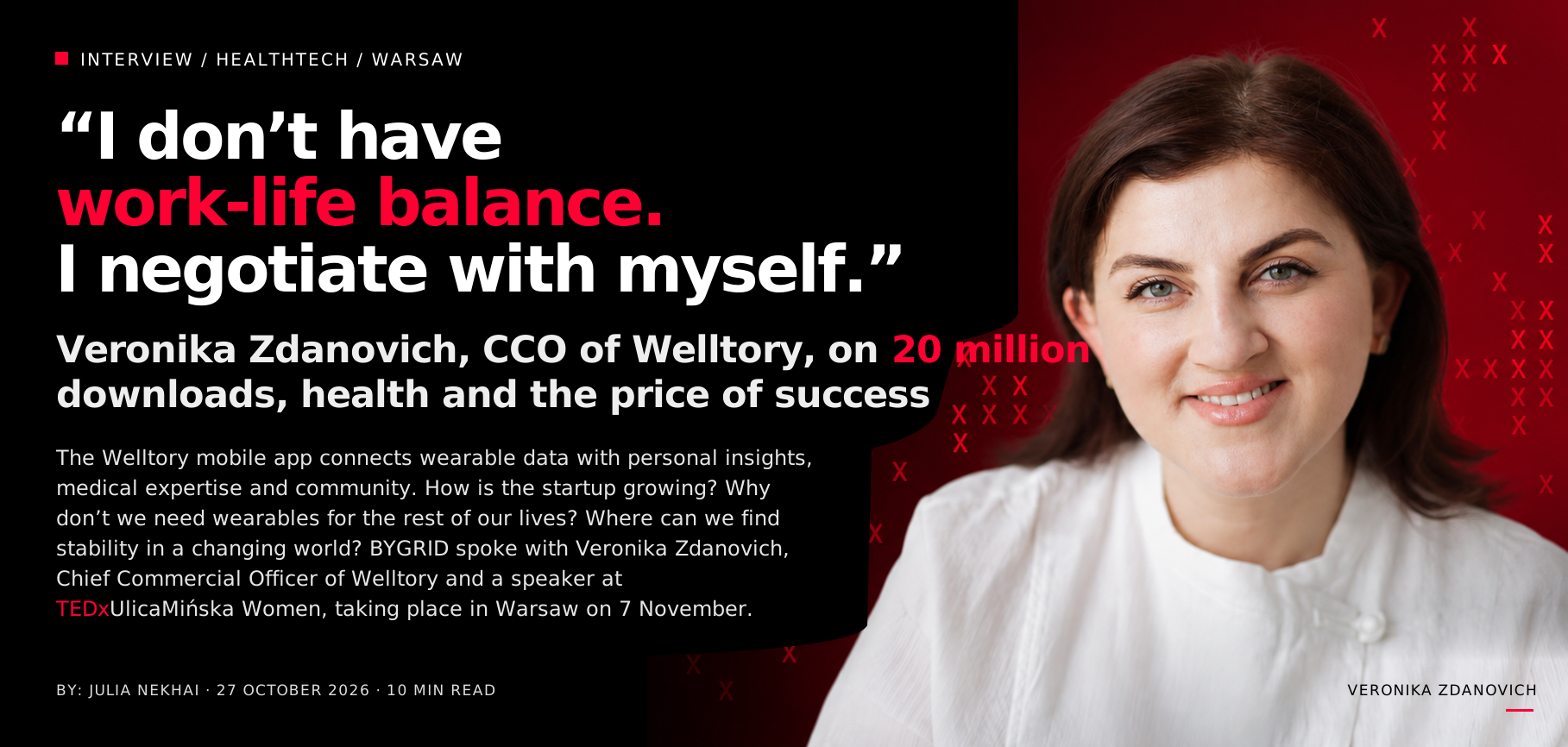
“I don’t have work-life balance. I negotiate with myself.” Veronika Zdanovich, CCO of Welltory, on 20 million downloads, health and the price of success
The Welltory mobile app connects wearable data with personal insights, medical expertise and community. How is the startup growing? Why don’t we need wearables for the rest of our lives? Where can we find stability in a changing world? BYGRID spoke with Veronika Zdanovich, Chief Commercial Officer of Welltory and a speaker at TEDxUlicaMińska Women, taking place in Warsaw on 7 November.
Contents
01Welltory metrics and strategy
“We’ve chosen to prioritise margins and independence”
Which figures best capture Welltory’s scale today?
— We recently celebrated 20 million unique downloads. Our monthly audience is around a million people. We expect annual recurring revenue to grow by 10%, to $16–16.5 million. We’re profitable and fund ourselves. We’ve chosen to prioritise margins and independence. Our founder, Jane [Smorodnikova], doesn’t want to lose control of the startup.
Why is she worried about losing control?
— Because we have the world’s largest database of heart rate variability (HRV) and health data. The US market alone accounts for 790 million measurements. These days, it’s difficult to avoid selling data and protect it from being used in other ways. Keeping our promises to users matters to us.
B2C wellness apps have challenging economics: acquisition costs, cancellations, LTV. What other metrics or achievements can you share?
— This year, lifetime value — the revenue a customer generates over their entire time using the product — grew by 30%. It’s 4.5 times our customer acquisition cost, or CAC. Paid traffic now accounts for 45%, down from 65% two years ago. We recently overtook Oura and Whoop in AI search.
I also want to stress that we mainly sell annual subscriptions. We don’t play games with trials or dubious resubscription schemes.
What about retention? The app is ten years old, after all.
— We were preparing an investor update yesterday: day-30 retention rose by 26% on iOS and 28% on Android. We put a lot of effort into telling stories through data so that every user could get their own insights. We learned to do more than display stress levels: we explain what causes stress and what helps that particular person manage it. That also boosted retention.
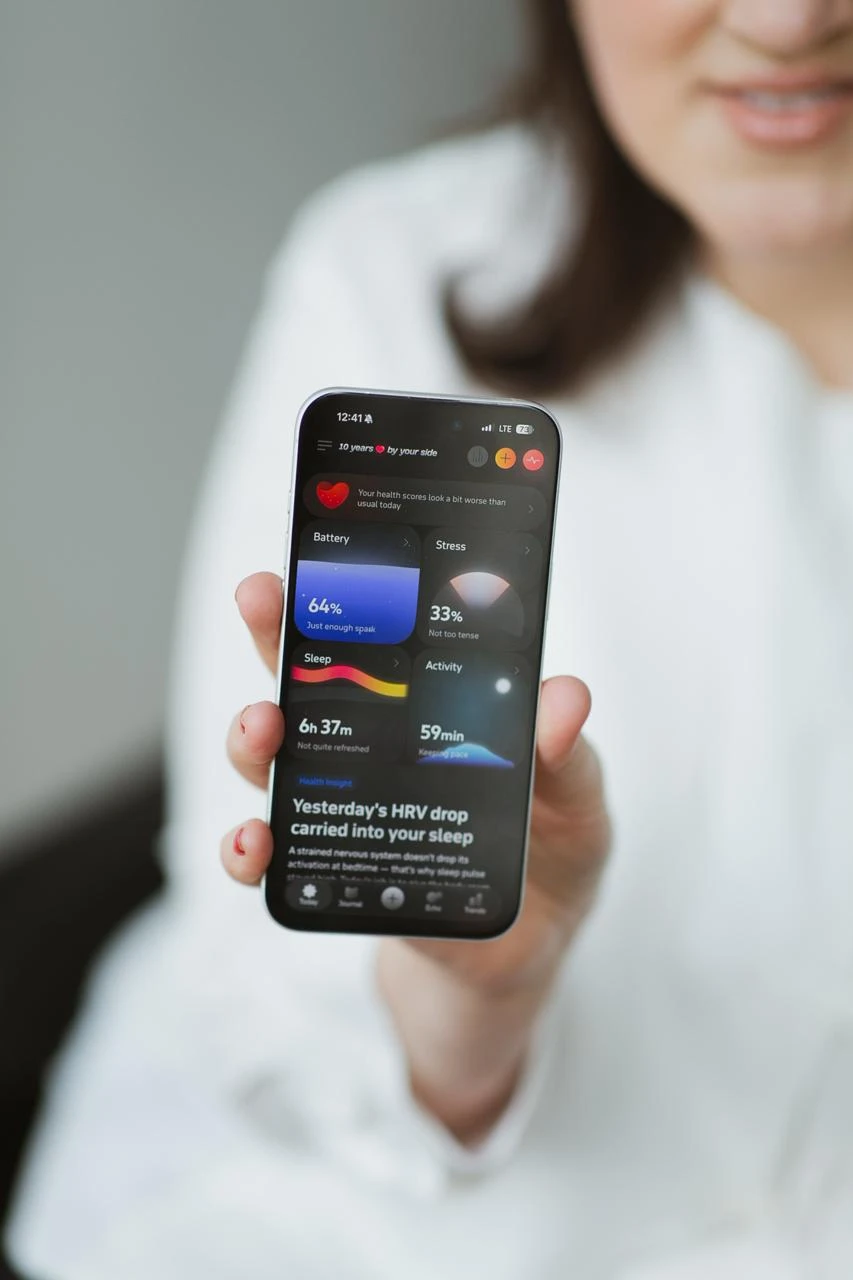
Photo courtesy of the interviewee.
We learned to do more than display stress levels: we explain what causes stress and what helps that particular person manage it.
02Welltory Care and Energy Lab
“You’ve seen me: I’m not making it up when I say I feel unwell”
What do you see as the next stage of Welltory’s development?
— We want to become part of people’s everyday lives — a kind of real-world embedding. Of our users, 65% want to manage their energy levels and understand where they lose energy. The other 35% are people with chronic conditions, such as migraine.
The subscription app market is no longer as sexy as it was seven to ten years ago. It’s becoming an ordinary market where the best at monetisation wins. We want Welltory to be a HealthTech product, rather than simply a subscription app.
That’s why we launched Welltory Care, which brings together wearable data, science, medical expertise and community support. Its first programme is Energy Lab. Annual participation costs $540, compared with $129 for a regular annual subscription. And 70% of participants buy an annual subscription.
Tell us more about Welltory Care. What kind of product is it?
— We started with a problem that’s relevant in the US, though not only there: you typically get about 15 minutes with a good doctor. What can they resolve in that time, especially with a complex chronic condition? We wondered: what if we brought together people who are as similar as possible? We use phenotyping for that — analysing symptoms and physiological measurements to form groups of people with similar conditions.
For the first Energy Lab, we brought together a group of women who wear Apple Watches continuously, giving us an uninterrupted data stream. All the participants also experience PEM, or post-exertional malaise: their condition worsens even after minor exertion. This can happen with Long COVID or POTS — postural orthostatic tachycardia syndrome — for example. In everyday life, someone might simply take a shower and then spend the rest of the day lying down. Their tests look fine, the doctor sees no problem, yet they can’t get out of bed.
With continuous data, we can see when a user is getting worse and tailor pacing — a strategy for balancing activity and rest. Our in-house doctors and scientists developed a specific methodology. Each participant now has an individual report showing what happens when she structures her day in a particular way.
We also created a Discord community and assembled a Medical Advisory Board, including researchers from Stanford and other universities. We bring similar cases together, and experts analyse them and offer recommendations.
In December, we’ll launch a second lab, focused on migraine. We’ve already built a dashboard that connects a diary of attacks with physiological measurements.
How do you identify connections between the measurements and what’s happening in a user’s life?
— For now, we offer deep personalisation only through Welltory Care. We don’t do it at scale, because inaccurate measurements can produce misleading correlations.
But if you take measurements correctly, you can understand what’s happening in the body at any given moment. For example, there were several stressful moments this morning when I was taking my children to their activities. You could see them in the app literally minute by minute.
Still, the greatest value of the first lab is in what the participants tell us: “You’ve seen me. I’m not making it up when I say I feel unwell.”
03Wearables, stress and health
“Wearables should teach you to understand your body”
How do you keep looking after your health from becoming another source of stress? Some people stop using Whoop or Oura altogether because they get tired of seeing poor readings.
— Our approach is human-centred. We would never gaslight a user.
Whoop originally focused on high-achieving men. They like that kind of thing: “Faster! More! You can do better!” Once the band became fashionable, people outside that target audience began wearing it, but that approach doesn’t suit everyone.
On a recent trip to Silicon Valley, I asked a friend to show me her Oura app. She said she couldn’t: the ring had run out of charge ages ago and she hadn’t charged it again. She too was tired of seeing poor metrics. (Why wear the gadget at all, then? As an accessory: it’s a good conversation starter at events.)
I think wearables should teach you to understand your body, and then their job is done. If someone has no health concerns, they don’t need constant tracking. Although life today means many people do need it.
So poor metrics shouldn’t determine how the next day goes?
— You shouldn’t live in a world where only good metrics count. Everything needs balance. On holiday, I can drink wine, eat oysters and avoid obsessively monitoring my HRV.
Longevity, in my view, is largely an invented marketing narrative. We don’t play that game at Welltory. Instead, we suggest “earning” good minutes for the following day, which might be stressful. For example, I had a good workout yesterday and “earned” 35 minutes for today.
But that doesn’t suit everyone: physical exertion can make someone with POTS feel much worse.
Earlier this year, you analysed data from 1.2 million US users and found a connection between stress levels and economic factors such as unemployment and income inequality. What other patterns have you noticed?
— How strongly everyday responsibilities affect energy levels. Our audience is women around 40 who have young children, ill parents and are entering perimenopause. They’re expected to perform at a high level at work, even though their nervous systems no longer bounce back like a spring.
Without context, though, it’s hard to quantify anything. My mother became seriously ill in the spring, and my HRV started falling. When I noted in the app that my mother was ill, it offered support. But without my explanation, the app wouldn’t have known what was happening in my life.
So in Welltory Care, we don’t simply bring together people with similar symptoms. We also consider women’s ages, menstrual cycles, perimenopause and menopause. And we always ask them to explain their life circumstances.
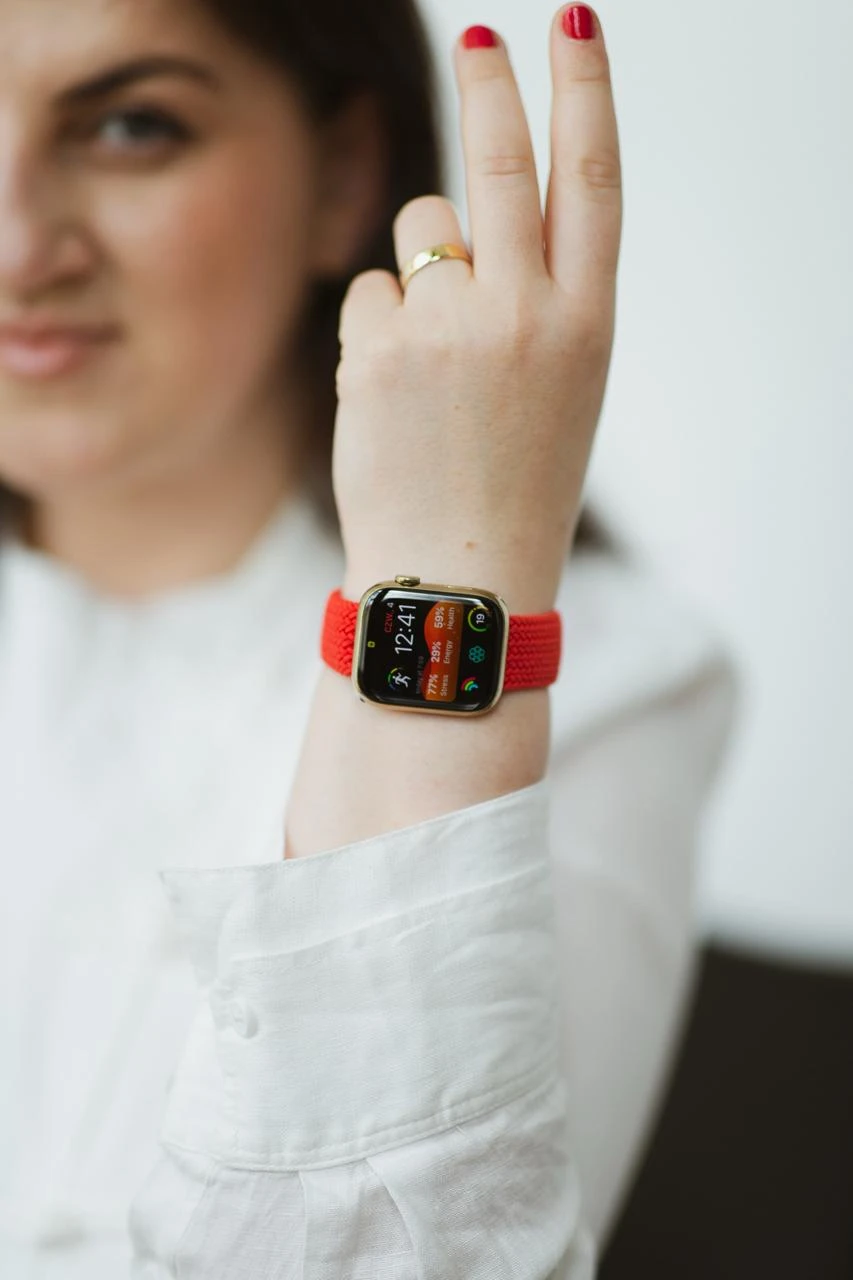
Photo courtesy of the interviewee.
Longevity, in my view, is largely an invented marketing narrative.
04Burnout and finding yourself
“My long-term life goal stopped sounding like a career goal”
For many people, work and career are central to their identity. But today, extensive professional experience no longer guarantees demand in the job market. Where can we find a sense of stability?
— I’ve made radical changes in both jobs and industries. I’ve come to believe that our competencies are built on an interest in solving something or achieving something. That interest is different for everyone.
After leaving Skyeng, I was so burnt out that I thought I would never feel that spark again. I spent six months lying around at home, thinking about becoming a florist or doing anything at all, as long as it involved no pressure.
But therapy helped me understand what interests me and what my values are. My long-term life goal stopped sounding like a career goal altogether. You need to ask yourself: what do I want to preserve as I go through these transformations? How can I be useful? What do I enjoy, what can I do, what do I want? It sounds like an Instagram cliché, but I don’t see another solution.
Can we even talk about long-term career planning today?
— It’s important and possible, but it should be based on the softer things within you, rather than on a company or job title. Even in 20 years, I want to be someone who finds it interesting to solve problems every day. That gives me a sense of fulfilment.
Photo courtesy of the interviewee.
You need to ask yourself: what do I want to preserve as I go through these transformations?